“Hope is a waking dream”

Flash Name

Just Appreciate What Still Remains...

Wednesday, 12 September 2012

I LOVE ePeee ( elephant )


Actually i just got it from my bestie..so i called it " ePeee "..TQ mumushh for the cute one.!

Wednesday, 1 August 2012

Dear Friends. . . .

Assalamualaikum..First of all, I want to thank my friends that helped me a lot. I'm very surprised once i got the task. I don't know what to post here, actually. I'm just typing as my mind thinking. I'm not master in this field even not a good practical. but I believe that effort will leads towards success. I'm trying to love you. I'm trying to make you as apart of my life. And...I will be loving you, MGT 300.! I can, therefore I am.

Opening Ceremony of the Symposium on Progress in Information and Communication Technology (SPICT'09)

December 7, 2009
UTAR brings together researchers, industry practitioners
and students in the fields of ICT

Researchers, industry practitioners and students in the field of information and communication technology (ICT) gathered at a hotel in Kuala Lumpur to witness the opening ceremony of the Symposium on Progress in Information and Communication Technology (SPICT'09) organised by Universiti Tunku Abdul Rahman (UTAR) on 7 December 2009.
The symposium which attracted the participation of individuals from all over the world brought together researchers, industry practitioners and students to exchange the latest advances and trends, and to identify and share emerging research topics in the field of ICT. A total of 64 paper submissions from over 31 different institutions in 12 different countries were received for the symposium, of which 31 submissions were accepted after paper review process.
SPICT'09 consisted of 7 sessions offering presentations in diverse areas of ICT such as business IT systems, network infrastructure, algorithm development, vision and image processing, knowledge management, multimedia and e-learning. Two ICT events were held simultaneously over two days in conjunction with SPICT'09. The events were the Workshop on Advances in Intelligent Computing 2009 (WAIC 2009) which was held on the same day as the opening ceremony of SPICT'09 and the Multimedia Development Corporation of Malaysia (MDeC) R&D Exchange Forum which will be held on 8 December 2009.
UTAR President Ir. Professor Dato' Dr. Chuah Hean Teik who was present for the SPICT'09 opening ceremony expressed, "The R&D landscape in Malaysia has transformed greatly in the past few years, where a lot of resources have been channeled in Malaysia to cultivate a vibrant environment for scientific and technological discoveries." He added that UTAR in tandem with the national development, is gaining greater momentum in the University's research intensification effort to transform into a research-intensive university.
"Our faculty members in UTAR are constantly seeking new opportunities, exploring innovative ideas and building new links. We have embraced this culture wholeheartedly and have maintained close collaboration with colleagues from various disciplines locally and worldwide through our Global Research Network and various research initiatives," he said.
He expressed his hopes for the SPICT'09 to present a platform to discuss, explore and allow ideas to cross fertilize to spark new research collaborations amongst the various participating academics and ICT companies.
Malaysian Deputy Minister of Higher Education Dr. Hou Kok Chung who declared opened the symposium said, "It is undeniable that technological advancement is an important tool in developing a nation. Hence, the Government of Malaysia has long recognised that ICT development would serve as an important strategic driver for positioning Malaysia as a competitive knowledge-based economy, and global ICT and multimedia hub."
He congratulated organisers and the sponsors, on their coming together to make the event a success and conveyed his belief that the efforts made by the them in making the event a success would play an important role in fostering the growth of the ICT industry to drive Malaysia's future economic growth.
Retrieved from  http://bellasup.blogspot.com/2011/08/it-news-from-universiti-tuanku-abdul.html
 

Unirazak aims to shape young minds, intellectual leaders of tomorrow


KUCHING: Universiti Tun Abdul Razak (Unirazak), established on Dec 18, 1997, was one of the first private universities in Malaysia.


ONE FOR THE ALBUM: (Seating from left) BPIEF finance Caren Christine Yee, BPIEF chairman Dorge Rajah, Unirazak Institut Pengurusan Dinamik chief executive Marzuki, finance director Hamizah Mohidin, admin and HR director Juriati Bujang with other Unirazak staff in a group photo.
Named after Malaysia’s second Prime Minister, the late Tun Abdul Razak, the university welcomed its first batch of 162 students in Sept 1998.
On Dec 21, 1998, the university was officially launched by Tun Abdul Razak’s eldest son, Datuk Seri Najib Tun Abdul Razak, the current Prime Minister of Malaysia.
Since then, Unirazak has become one of the first private learning institutions in Malaysia to receive the Sirim certification of ISO 9001:2000.

Additionally, the university has been awarded the prestigious MSC-status certification, a testament to the university’s commitment in integrating technology and innovation in its teaching and learning techniques.
Although Unirazak is a relatively new university, it is rapidly establishing itself as a centre for education.
Unirazak Sarawak Regional Centre, managed by Institut Pengurusan Dinamik Sarawak is an educational institution which manages programmes for Sarawak region.
Established in 1998, the institution offered top quality programmes ranging from Diploma to Bachelor’s Degree. Strategically located at Jalan Haji Taha, the campus is in close proximity to banks; a mosque, a Sikh temple, Tua Pek Kong temple, food court, and even shopping complexes, within walking distance.
The campus is easily accessed, as it is situated in the middle of Kuching City, with bus terminals, taxi stations and even ‘penambang’ jetties, connecting all routes toand- fro from the campus to the city.
The campus itself consists of a main building; Wisma Mornie and another adjoining block, Annex Block and has a capacity of fourteen lecture rooms, one main hall, three computer labs, one resource centre and one student common area.

All lecture rooms are fully air-conditioned and equipped with LCD and laptops to facilitate for a more interactive learning experience.

The computer labs, which have more than 100 computers all has Internet access and fully installed with all the relevant softwares required for students usage.

Even the campus itself is wired with WiFi which enables students to connect to the Internet wherever they are whether in classrooms, students’ common area, resource centre or even in the main lobby.
This is in line with Unirazak’s learning concept which combines face-to-face classes with its virtual online instructional support system (VOISS).

Students can gain access to their notes, tutorials and announcements online while being in a face-to-face class.
Their mission is to equip students with quality knowledge and skills that meet their personal growth needs and the expectations of chosen profession and industry through the provision of above average learning opportunities and educational support services.

Unirazak Sarawak Regional Centre offers six academic programmes at the diploma and undergraduate levels – Diploma in Management, Diploma in Early Childhood Education, Bachelor of Business Administration (Hons), Bachelor of Education (Hons), Bachelor of Management (Hons) and Bachelor of Hospitality Management (Hons).

All their academic programmes, which were developed through close consultation with business and industry partners, the public sector and professionals, are approved by Malaysian Higher Education Ministry (MOHE) and are developed to meet the high standards required by Malaysian Qualification Agency (MQA).

 
FROM  http://www.bpief.com/2010/12/unirazak-aims-to-shape-young-minds-intellectual-leaders-of-tomorrow/

UCSI UNIVERSITY AND MAXIS TEAM UP TO BRING HIGH-SPEED INTERNET TO STUDENTS

Kuala Lumpur, 22 Apr, 2011 - UCSI University and Maxis Berhad are teaming up to offer University students high-speed Internet access. The two entities established a smart partnership today as part of the Maxis Integrated Partner in Education (MIPE) programme that launched last week. Under the agreement, Maxis will provide high-speed Internet to the University and become one of the University’s industrial partners. UCSI University Vice Chancellor, Dr Robert Bong and Senior Vice President for the Maxis Business Division, Mr. M Fitri B. Abdullah, signed a certificate of partnership in front of a crowd of nearly 200 students during a ceremony at the University. 


In his speech, Dr Bong said the partnership is part of UCSI University’s commitment to bring in modern technology to augment its teaching and learning environment. He said the University is currently pursuing software that will allow lecturers to create virtual “classrooms” with lectures, materials and forums online.


“Our goal is to provide our students with the skills and knowledge to succeed in life in the most effective way possible,” he said. “With blended learning, we will be able to use a variety of tools to make both teaching and learning more efficient, more relevant and more accessible through modern technology.”


Under the agreement, Maxis will provide high-speed WiFi services of up to 50mbps that can be subscribed to directly using mobile phones. 


The Maxis WiFi service will enable students to interact with their lecturers outside the normal classroom setting, combining the usual face-to-face learning with online delivery methods as part of the University’s blended-learning teaching philosophy, championed by its Faculty of Education and Centre for Learning Excellence. The high internet speed will also enable students to quickly download podcasts of their lectures, access online resources, conduct research and join online group discussions, enhancing their learning experience. The availability of high-speed internet access across campus grounds also increases student connectivity and mobility, creating a conducive environment for one to learn on the go. The WiFi service is currently on a free three-month trial basis, after which it will be available at a low daily, weekly or monthly rate for students.


The partnership with Maxis will enable UCSI University to enrich the university experience for its students, with the introduction of the University Hot Ticket, a supersaver prepaid card from Maxis, customised to suit the University’s academic, community and social events. Maxis will be contributing part of the sales for the prepaid cards to social causes and events championed by the students, heightening student awareness of and participation in, community and social issues. 


Maxis and the University’s Faculty of Management and Information Technology are also working together to fulfill the MIPE commitment to developing student entrepreneurship. UCSI University is the first out of Maxis’ tertiary education partners, to deploy Hotlink dealership kiosk businesses on-campus. Currently, there are two kiosks in operation, offering students preferential incentives as well as further blended learning opportunity to put into practice lessons from business courses and to take away new experience from a current communications business model. 


Mr. M Fitri B. Abdullah in his speech said, “On 5 April, Maxis launched its Maxis Integrated Partner in Education programme, a unique offering of an end-to-end array of integrated services to the university sector. Today, we are pleased to see the promise of education enabled by communications technology and partnership commitment, bearing its first fruit at UCSI University.”


“At Maxis we certainly believe in the power of integration of strengths from different areas to create a synergistic service ecosystem and unique customer experience which is greater than the sum of its parts. We can see that the committed and innovative staff and students of UCSI University also believe in the spirit of combining capabilities and of reaching across borders, to arrive at a form of knowledge and preparedness which will truly mark them out as the next digital native generation.”


New international students at the University will also benefit from the partnership, with a special bundled package made available by Maxis and UCSI University. They will receive both prepaid mobile services and broadband internet worth RM200 for free upon their arrival at the University. This ensures better integration for the international student community on campus with the local community while easing their transition to their new life in the country. 


Through this smart partnership, Maxis will also be part of the University’s Co-Operative Industrial Placement Programme, which currently has close to 900 industrial partners. This allows internship opportunities for UCSI University’s students, who need to complete at least two months of industrial training in each academic year. This format, unique to the University, ensures students are constantly in touch with industrial practices, while applying what they have learnt in the classroom. 


In conjunction with the University’s 25th Anniversary, UCSI University and Maxis also recently worked together on a major charity project worth more than RM40,000, which involved more than 200 students. The students and staff of Maxis visited 25 charity homes in a day to paint and clean up the homes, and also to interact with the residents in fun games and activities.

Wednesday, 25 July 2012

UTAR, MMU Host Conference on High-Impact Technology

Universiti Tunku Abdul Rahman (UTAR) and  Multimedia University (MMU) jointly hosted the 16th Pacific-Asia Conference on Knowledge Discovery and Data Mining (PAKDD),  the first PAKDD in Malaysia, which kicked off at a renowned hotel in Kuala Lumpur on 29 May 2012.


Spanning three days from 29 May - 1 June 2012, the conference featured three keynote addresses by world-renowned data mining experts, HP Senior Fellow Chandrakant D Patel, Professor Dr Charles Elkan from the University of California at San Diego, and Professor Dr Ian Witten from the University of Waikato.


The conference covered the field of Knowledge Discovery and Data Mining (KDD), which is fast becoming the tool of choice for world-class business leaders for the purposes of business decision support, customer relationship management as well as business development. KDD uses statistical, mathematical and IT methods to discover knowledge that is otherwise obscured in databases.


The Pacific-Asia Conference on Knowledge Discovery and Data Mining (PAKDD) is one of the longest established and leading international series of conferences in the areas of data mining and knowledge discovery.  It serves as an international forum for researchers and industry practitioners to share their latest developments, new ideas, original research results and practical development experiences from all related areas such as data mining, statistical and symbolic machine learning, databases, knowledge acquisition and automatic scientific discovery, data visualization, and knowledge-based systems.


"The choice of Malaysia as the host for PAKDD this year is a strong indication that the KDD community in the region recognises that their Malaysian peers are progressing actively in this area," said this year's Conference Co-Chair Professor Dr Ewe Hong Tat, Vice President (Internationalisation and Academic Development) of Universiti Tunku Abdul Rahman.
Conference Program Co-Chair Associate Professor Dr. Ho Chin Kuan, Dean of Faculty of Computing and Informatics at Multimedia University, expressed his excitement about PAKDD 2012 being hosted in Kuala Lumpur. "KDD is an extremely useful tool that allows businesses to discover new knowledge that is currently hidden in their databases," he said. "It allows them to discover, among other things, the buying patterns of their customers, who their best customers are, and many other interesting patterns. The conference will provide a good opportunity for local data professionals to acquire cutting-edge knowledge in the field through the conference talks, tutorials and workshops, and to network and interact productively with the foreign participants."


The other two conference co-chairs of the PAKDD 2012 were Professor Dr Philip S Yu, Professor and Wexler Chair in Information Technology, Department of Computer Science, University of Illinois at Chicago, USA and Professor Dr Lim Ee Peng, Professor of Information Systems and Director of Living Analytics Research Centre, Singapore Management University, Singapore. The other two program co-chairs of PAKDD 2012 are Associate Professor Dr. Pang-Ning Tan of the Department of Computer Science & Engineering, Michigan State University, USA and Professor Dr. Sanjay Chawla of the School of Information Technology, the University of Sydney, Australia. 


The three sponsors of the conference were Telekom Malaysia Berhad, the Asian Office of Aerospace Research and Development, the US Air Force Office of Scientific Research; and leader in business analytics software, SAS.  It is supported by Multimedia Development Corporation (MDeC) and National ICT Association of Malaysia (PIKOM).

PAKDD had its inaugural debut in Singapore in 1997, and since then it has been hosted annually in various cities in the region before coming this year to Kuala Lumpur for the first time.  The 16th PAKDD in Kuala Lumpur will be held from 29 May to 1 June 2012.  Besides Singapore, which also hosted the conference again in 2006, the other cities were Shenzhen (2011), Hyderabad (2010), Bangkok (2009), Osaka (2008), Nanjing (2007), Hanoi (2005), Sydney (2004), Seoul (2003), Taipei (2002), Hong Kong (2001), Kyoto (2000), Beijing (1999), and Melbourne (1998).


In addition to the main conference, there were four workshops, three tutorials, and a doctoral symposium. The proceedings of the conference will be published by leading international publisher Springer under the Lecture Notes in Artificial Intelligence series. In conjunction with this, a data mining competition with two different categories was also organised. The Open Category of the competition challenged participants to predict churn and win-backs in the telecommunication industry. The Student Category required students to use SAS data mining software to identify the correlation between the number of job applications and Malaysia's economic indicators. The data for the student category were provided by JobStreet while the student category prizes were sponsored by SAS Malaysia. 


As a respite to the intense and intellectually demanding sessions, PAKDD participants got to enjoy several social activities such as a welcome reception on the first day, a conference banquet on the second day, and a city tour to conclude the event on the third day.  The conference attracted over 150 participants from more than 30 countries.

Prof. Ewe Hong Tat addressing the audience at the opening of the conference 

PAKDD participants listening to  Prof. Charles Elkan present his keynote speech


From left to right:  Prof. Tu Bao Ho (PAKDD steering committee co-chair), Andrew Tan (Managing Director of SAS), Prof. Hiroshi Motoda, Scientific Advisor and Program Manager (Asian Office of Aerospace Research and Development (AOARD) and Air Force  Office of  Scientific Research (AFOSR)), Prof. Graham Williams (PAKDD  steering committee chair), Prof. Tou Tou Teck Yong (Vice President R&D of MMU), Prof. Ewe Hong Tat (Vice President of UTAR), Mr Liew Hon Chuen   (representing TM Malaysia Sdn Bhd), Mr. Ong Kian Yew (Executive Director of PIKOM), Prof. Pang Ning Tan (PAKDD Program Co-chair), Prof. Chin Kuan Ho (PAKDD Program Co-chair), Dr. Victor Tan (representing Multimedia Development Corporation MDEC)
Industrial and research demo session
 
 
Retrieved from: http://www.utar.edu.my/contentPageNewsAwards.jsp?catid=16&contentid=3191
 

UKM Placed Second In The Ministry Of Higher Education Innovation Award 2011

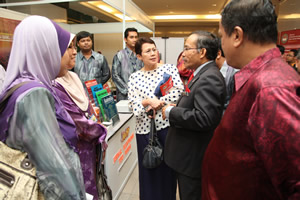
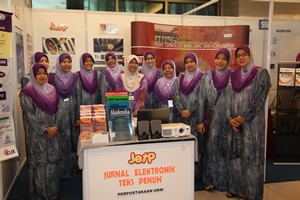
BANGI, 4 Nov, 2011 – The National University of Malaysia (UKM) won second place in the Innovation Award 2011 of the Ministry of Higher Education (AIKPT 2011) with its project – Full Texts Electronic Journal: e-Journal Texts High Impact Search Centre (JETP).

Minister for Higher Education, Dato’ Seri Mohd Khaled Nordin presented the award - a trophy, certificate and cash of RM3,000 - to UKM Vice Chancellor, Prof Tan Sri Dato’ Wira Dr Sharifah Hapsah Syed Hasan Shahabuddin at a ceremony in Putrajaya yesterday.

JETP has last April won the UKM’s ICT Innovation Award and was the first runner-up at the ICC Malaysian Libraries Convention in Jun.

The Community College Study Department of the Ministry with its project ‘The Management of Information Using ePSH Based on On-Line Technology to Monitor Study for Life’ won the AIKPT 2011 award.

The Sultan Idris Teaching University (UPSI),Tanjung Malim came in third for its project, the University’s Integrated Information System.

The AIKPT Innovation Award has been held since 2009.This year’s award was on the theme “Innovation Spear heading the Ministry of Higher Education’s Transformation”.

A total of 50 innovation projects were received by the organising secretariat with 35 of them found to be qualified for competition after fulfilling the required conditions.

Out of the 35 selected, 13 were shortlisted for assessment with seven eventually competing as finalists which involved site visits.

The Senior Librarian of UKM’S Tun Seri Lanang Library (PTSL), Shamsudin Ibrahim said JETP was designed by the Innovative and Creative Group (KIK KLIK) from PTSL. The group consists of 14 staff of differing grades who began working on it in May 2010 and managed to finish the job within three months by July.

JETP can be access anywhere through URL http://www.eklik.ukm.my/jetp

It consists of 27,000 e-journals, 25,000 e-journals subscribed by UKM Library and another 5,000 without charge access in the internet.
 

JETP was built using the open source software, with no built-up costs thus saving the university up to RM100,000 if it had been developed by third party sources. It also enabled a savings of up to RM30,000 a year for UKM since the university’s users no longer needed to subscribe to overseas sources for information now made available through the facility.

Shamsudin said to date more than 150,000 access has been recorded an increase of over 200% compared to what was recorded last year.

“Users from 25 countries besides Malaysia were found to have accessed JEPT since they can also access it through smart phones and tablets apart from the internet.

“We have also made presentations to libraries in other institutes of higher learning in Malaysia and have received very good response,” he said.

Shamsudin said UKM users can check for articles in journals using JEPT while those outside the campus can go through the Suppliers Publications Services.

It also contained learning modules for Information Skills Courses used by library users andto check other journals to subscribe or referrals to the Reader’s Counseling Desk.

Besides the ministry’s award, JETP is also a finalist in the National Innovations Award. The final assessment for it will be held at PWTC on 15-16 November.

JETP will be commercialized through a UKM Start Up Company, UKM Technology Sdn Bhd once the updated version JETP 2.0 now in the final stage of development is ready for marketing by December.

JETP received RM100,000 from the UKM Innovation Fund last June for the JETP 2.0 update.

Shamsudin said JEPT had also resulted in time savings for its users since the search for high impact e-journals had been reduced to just two minutes down from 25 minutes needed previously.

“JETP also helpsin the sharing of information sources at the national level through Borrowings Between Libraries. PTSL has since  recorded 2.1 million down loadings for its full texts articles in 2010.

“The returns from our investments isRM2.40 per article of full texts since libraries subscribed to our e-journals. Otherwise researchers, academicians and UKM students who needed to buy full text articles will have to pay RM80-RM120 per article for down loading,” Shamsudin said. 

By Abdul Ghani Nasir
Pix by Ismail Ibrahim
 Friday, 04 November 2011 00:00 

Retrieved from: http://www.ukm.my/news/index.php/en/component/content/article/70-current-campus-news/887-ukm-placedsecond-in-the-ministry-of-higher-education-innovation-award-2011-.html


UTAR joins YTL Communications’ Education Partner Program

Petaling Jaya, 27 July 2010 – Universiti Tunku Abdul Rahman (UTAR) joined YTL Communications Sdn Bhd (YTL Comms)’s Education Partner Program (EPP) today and signed a Memorandum of Agreement (MoA) to jointly deploy a campus-wide 4G network at the UTAR flagship campus in Kampar, Perak. Subsequently, similar deployments will be carried out at all UTAR campuses at Setapak, Sungai Long, and Petaling Jaya.

UTAR joins YTL Communications’ Education Partner Program

This marks another major milestone in the extensive EPP project spearheaded by YTL Comms to bring 4G converged service, offering data, voice and mobility to all public and main private universities in Malaysia. UTAR is the first private university to join EPP with UTM as the first public institution of higher learning we signed up earlier.

“We believe that being part of EPP will transform the way of life on our campuses. 4G Mobile Internet will provide new levels of interactivity among students and faculty personnel. Also, being a university that delves in extensive research work we are happy with the new innovative functions and capabilities our researchers will have access to with 4G Mobile Internet,” said Ir. Professor Dato’ Dr. Chuah Hean Teik, President of UTAR.
According to Professor Dato’ Dr. Chuah, this partnership will empower 12,000 students in the UTAR Kampar campus, and another estimated 7,000 students in all of the UTAR campuses around the Klang Valley, with enhanced accessibility to both Intranet and Internet facilities throughout the campus grounds.
Under the EPP, all UTAR students will enjoy high-speed, wireless broadband access at anytime and from anywhere within the campuses. Every student will get converged data and voice services totalling 300 Megabytes per user, per month for a period of 3 years.

“As we bring our 4G network capabilities to all Malaysians, it is crucial that we give special consideration to our university students, the pillar of our future. Therefore we are very pleased that UTAR has joined our EPP. We will be working closely together to foster a new generation of progressive, tech savvy and innovative students that are able to create a positive impact to the development of the nation,” said Wing K Lee, CEO of YTL Comms. “Malaysian students are among the first, if not the first in the world to have such pervasive use of the most advanced Internet technology today”.

“Students are constantly moving, always communicating on-the-go, and have this endless need for information to supplement their studies, course-works, and daily lives. Wherever the student sits or ride is a potential seat for learning and development. While on campus, they can open their laptops and immediately connect to the world – anywhere, anytime,” Professor Dato’ Dr. Chuah explained.

Once the infrastructure is up and running, UTAR will be working closely with YTL Comms to nurture the development of Internet applications in the university’s technology degree courses.
“We plan to make YTL Comms’ 4G Mobile Internet the foundation in our center of excellence for the 4G network applications and devices our students are developing. On the Kampar campus alone, we have an immediate sample size of 12,000 users to carry out our research on the 4G network in our efforts to further advance the telecommunications engineering courses”, elaborated Professor Dato’ Dr. Chuah.
Present to witness the signing ceremony was Tun Dr. Ling Liong Sik, Chairman of the UTAR Council, members of the UTAR council, Professor Dr. Lee Sze Wei, Vice President (R & D and Commercialisation), UTAR, Jacob Yeoh, Executive Director of YTL Comms, and the senior management of YTL Comms.

Retrieved from: http://www.ytlcomms.my/EN/news_details.aspx?id=23

Creating Malaysia's First 4G Campus-wide Network

Skudai, 1 July 2010 – YTL Communications Sdn Bhd (YTL Comms) today entered into a Memorandum of Agreement (MoA) with Universiti Teknologi Malaysia (UTM) in a joint collaboration to provide 4G campus-wide network in UTM Skudai. This effort is in support of the National Broadband Initiative (NBI) aim to reach 50% broadband penetration rate by end-2010.
Creating Malaysia's First 4G Campus-wide Network
This landmark initiative will be the first of an extensive program spearheaded by YTL Comms to bring 4G converged service, offering data, voice and mobility into all public universities in Malaysia. 
As a result, YTL Comms will make available that high-speed wireless broadband connectivity to more than 400,000 students by year-end and correspondingly increase broadband penetration rate throughout the country.
“The signing of our agreement with UTM today marks an important milestone to build a new generation of immersive and progressive students that are able to access information and knowledge instantly at their finger tips. The YTL Comms Education Partner Program (EPP) provides the ability for these students to access the IntraNET and Internet anytime, anywhere within the campus. The EPP allows our students to do things differently and bring about a wave of positive changes in a YTL Comms 4G enabled education environment that will eventually contribute to the larger future success of the nation. ” said Tan Sri Dato’ (Dr) Francis Yeoh, Executive Chairman of YTL Communications.
Under this arrangement, YTL Comms will at its own cost undertake the following:
  • Design, build, operate and manage a 4G campus-wide network (for the provision of data and voice services within the university’s Skudai campus).
  • To complement and enhance UTM’s existing ICT infrastructure.
  • Provides free broadband access to every student, allowing data and voice services of 300 megabytes per user per month within the campus.
  • Provides the program for a period of 3 years from launch.
The 4G campus-wide network is a high performance, high-capacity wireless network, which is optimized for dense mobile broadband access with voice services. It will support UTM’s commitment to develop a highly advanced learning environment for all their students and help the University, to enhance its position as a cradle of technology excellence in the nation and the world. Thus, this will make UTM to be more competitive in attracting top-class student applicants and faculty staff. 
“We’re on the cutting edge of new technology, the first university in Malaysia to gain exposure to high-speed 4G broadband wireless connectivity,” said Prof. Dato’ Dr. Ir Zaini Ujang, Vice Chancellor of UTM. 
“Having 4G campus-wide network makes UTM unique, it provides a competitive edge to demonstrate to prospective students that we are progressive in developing new technologies and also provide current students with immersive learning”, added Dato’ Dr. Zaini.
The low latency, high bandwidth 4G technology supports fast data rates, is highly spectrally efficient, and is developing a robust device ecosystem. As an all-IP technology, it is optimized for web services. Members of UTM Skudai community will soon be using and evaluating new learning approaches enabled by high speed wireless broadband. In particular, they are focusing on immersive learning environments harnessing advanced multimedia techniques.
The event commemorates the launching of YTL Communications EPP and the signing of the MoA with UTM, the first university under this program by YB Dato’ Seri Utama Dr. Rais bin Yatim, Minister of Information, Communications and Culture.

Retrieved from: http://www.ytlcomms.my/EN/news_details.aspx?id=22

Wednesday, 11 July 2012

USE TECHNOLOGY TO SEEK KNOWLEDGE

Penang, 31 May: Developments in communications and information technology have brought about changes to society and university students, specifically those in distance education. This group of people should use technology in seeking knowledge.

According to the Acting Vice-Chancellor of USM, Assoc. Prof. Omar bin Osman, technological developments have created societies that are information-based that will enable them to compete globally.

“However, all knowledge available at the finger tips will not be of use if students do not strive to master the technology. The ability to master technology such as the Internet will give students the competitive edge and ensure that they are not left behind in their pursuit of knowledge,” he said at the Distance Education Students Welcoming Ceremony in conjunction with the Distance Education Orientation Week from 28 May to 1 June 2007.

About UM SMS Service (2003 - 2008)


Retrieved from: http://ict.um.edu.my/?modul=Articles&pilihan=Display&id=230
History Of UMSMS (2003-2008)


UMSMS stands for University of Malaya Short Messaging Service. UMSMS service was first started in 2003. The initial objective of providing the service was to allow students to access information conveniently via mobile phones alternative to those provided by Umisisweb an internet based system. The move to implement the service was to augment the existing internet based service catering for students who do not have access to internet.


Right from the start of its implementation in 2003, UMSMS service connects seamlessly with the relevant internal systems so as to generate the related info of the student. The UM SMS platform used at that point of time was an independent platform initially using 39339 as its SMS service number. Usage of such service is much lower in volume as compared to its internet based counterpart since access to info via SMS is NOT free.


In early 2008, MAMPU initiated the e-KL initiatives. UM and other government agencies becomes part of the e-KL. The key objective of e-KL is to support the Electronic Government initiative. Middle of 2008, UM SMS ‘ s platform was  redirected from the old number to the new e-KL number which is 15888 in support of the e-KL and to leverage on a lower SMS charges guaranteed by e-KL.


The need to use new means of communication in UM besides existing electronic mail and manual fliers and notices increases late in 2009. It started with Faculty of Medicine who requested to use the SMS service to broadcast special messages according to student groups.


Thus, realizing the fact that , it is possible that in future other Faculties or Administrative office might require similar alternative means of communication, PTM’s UM SMS team from Collaborative application division is now in the process of developing an administrative UMSMS portal to cater for the distributed needs. The development is expected to finish by end of 2010.


 WHAT IS GSM


GSM stands for Global System for Mobiles. This is a world-wide standard for digital cellular telephony, or as most people know them Digital Mobile Telephones. GSM was created by Europeans, and originally meant “Group Special Mobile”, but this didn’t translate well, so the now common more globally appealing name was adopted. GSM is a published standard by ETSI, and has now enjoys widespread implementation in Europe, Asia and increasingly America.


 WHAT IS SMS


SMS stands for Short Message Service. It is the ability to send and receive “Short Messages” to and from GSM handsets, or as they are named by ETSI ‘Mobile Terminals’ (MT).


A “Short Message” can contain up to 160 characters in one message, which is quite a lot when you think about it, most messages are simply a call me back, or pick up the parcel from here. The biggest problem with SMS is getting a big screen big enough on the mobile phone to be able to read them easily.


SMS is a really nice feature of GSM, being able to give someone a message without actually speaking to them is a great time saver, and results in less misunderstanding; it is kind of like e-mail in your pocket.


 CURENT/EXISTING UM SMS APPLICATIONS


Current UM SMS hosts following functions accessible to UM Undergraduate student:
1. UM YURAN / UM BAKI
2. UM JADUAL
3. UM EXAM
4. UM KURSUS
5. UM PENSYARAH
6. UM RESULT


Go to Umisisweb (panduan sms) for the 'How To Access' instructions.


 EXISTING UM SMS ARCHITECTURE CONTAINS THE FOLLOWING:
1. UM SMS Application Server – located in PTM and managed by PTM
2. SMS Centre – located  in PTM and managed by vendor
3. UM SMS Application server is the server where we put UM’s customized application.
a) The server will receive the username and password from a student and query the required result and then send it back to the user via SMS through the SMS gateway.
b) UM SMS Centre server is the gateway that passes the result from the application server to the SMS gateway and vice versa.
4. The SMS GATEWAY is a server which is connected to several GSM modem. This is the point where result from UM SMS Centre is sent before it is sent to the GSM networks subscribed by the user.
5. Both UM SMS Centre and the SMS GATEWAY are being managed by the vendor. Therefore, to cater for other SMS application server, extra customization will be required to be done to the server itself. This is beyond the boundary of UM system administrators.


 STEPS FOR UM STAFF OR STUDENT WHO ARE INTERESTED IN USING THE EXISTING UM SMS GATEWAY :
There are 2 options to consider:
a) Obtain your own GSM Modem (e.g  Wavecom FASTRACK Modem with your own SIM card)
b) Use existing UM SMS Gateway.


If you are a UM student who would want to use the SMS as part of your project. It is advisable that you choose option A. If you need consultation on how to set up, you can contact our PTM personnel, Encik Adnan Yahya, at 03-7967 4005.
Otherwise, if you decide to use the existing UM SMS Gateway (option B) then you will need to:
1) write to Pengarah PTM stating your request. (PTM will arrange  discussion and meeting with the vendor who are responsible for the SMS Centre)
2) prepare your own server to host your own SMS Application.
3) prepare your own budget for the usage and extra customization needed to get your sms applications running.


UKM Places Great Importance to Visual Informatics Research

Thursday, 10 November 2011 22:20
Print PDF
By Radzuan Ghazali
Pix Mohd Hairul Azmi Jahid

BANGI, 9 Nov. 2011 – The National University of Malaysia (UKM) places great importance to research in information and communications technology in line with the National Digital Transformation Plan that can spearhead the country’s economic development.

Deputy Vice Chancellor  (Students and Alumni Affairs) UKM, Prof Ir Dr Othman A. Karim said the university has been allocated a sum of RM44million under the 10th Malaysia Plan for research in the area against an allocation of only RM3million under the sixth plan.

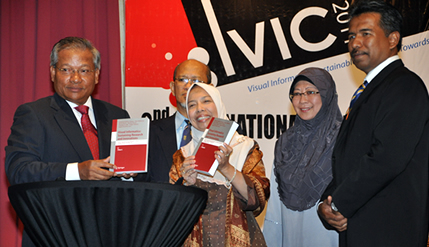
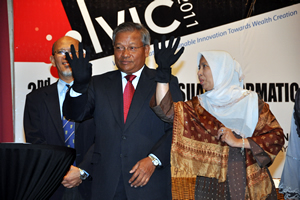
Speaking at the opening of the International Conference of Visual Informatics at the Equatorial Hotel here today he expressed confidence that the Ministry of Higher Education will continue to support the university to undertake research and innovations in informatics.

The three day conference is organised by
the Institute of Visual Informatics UKM and Faculty of Information Science and Technology, UKM with the theme ‘Virtual Informatics: Sustainable Innovations Towards Wealth Creation’.

It is attended by some 150 engineers, academicians and those involved in the industry worldwide. A total of 71 papers have been tabled for discussions.
Chairman of UKM Board of Directors, Tan Sri Zulkifli A Hassan  who officiated the opening on behalf of the Minister of Higher Education said informatics technology plays a very important role in revolutionising and supporting various sectors including education, communications, health care in addition to biotechnology and genetic engineering and visual informatics.

He said visual informatics was especially relevant in education as it has the widest reach compared to the traditional method thus allowing more people in the country to have access to it.

 
Since the setting of the Malaysia Super Corridor (MSC) 2,455 companies including institutions of higher learning have been given MSC status with 2,574 IPs registered.
Prof Dato’ Dr Halimah said the conference is a platform for academics and professionals and experts in visual informatics to share their experiences and information and was confident that participants would greatly benefit from it. 


http://www.ukm.my/news/index.php/en/extras/890-ukm-places-great-importance-to-visual-informatics-research.html

FSKTM Students Represented UPM in Imagine Cup

Retrieved from: http://www.researchsea.com/html/article.php/aid/6206/cid/2/research/fsktm_students_represented_upm_in_imagine_cup.html?PHPSESSID=ujcrd38cvikh221lht0kuh7h31

Three students from the Faculty of Computer Science and Information Technology (FSKTM), Universiti Putra Malaysia (UPM), were selected to represent UPM at the 2011 Malaysia Imagine Cup competition recently.


Image Name
Mohamad Najib Basery, The Green P
The FSKTM team is led by their mentors, Dr. Lili Nurliyana Abdullah, Dr. Razali Yaakob and Dr. Rohaya Latip.


Namely the Green P, they created the 'Botanic Sustainability Smart System', a web based software to identify the type of soil and suitable plants that can be planted with it.


A second year student in Bachelor of Computer Science (Computer Networks), Mohamad Najib said the idea to develop the software was drawn from the famine situation in Africa. Thus we are inspired to help them in identifying suitable crops for their land.


"It took us almost two months to develop this system as well as data collected from the Ministry of Agriculture and Agro-Based Industry (MOA), Institute for Research and Development Institute (MARDI) and assisted by Prof. Dr. Kamaruzaman Joseph from the Faculty of Forestry, "he said at the Malaysia 2011 Imagine Cup competition at the Pullman Hotel, Kuching.


In addition, the system is able to analyze the crop price index, which enables those involved in the agricultural industry to determine their budget in order to initiate agricultural projects.


Meanwhile, WASPending developed software that combines the teaching of general knowledge, science and math, and also a hero character as well as focused history for students aged 10 to 12 years old.


WASPending team leader, Wong Ching Yee said the system called 'Challenge the Difference "was developed in the form of games and educational software.


"I hope that this software will draw attention from the children’s education related industry," he said.


His friend, Tan Wee Chong, a final year student of Bachelor of Computer Science (Software Engineering) from The Frontiers said his group developed 'The 1 Cent Project' a micro donation system that integrates with telecommunication companies to further promote the culture of giving among students.


"Students can donate as low as one cent, and the use of the software can be promoted by the telecommunications company as a community service program (CSR).


"By using this system, users can select their donation to be distributed for non-governmental organizations (NGOs), the amount to be donated and the identification number and the data will be verified by the telecommunication companies after obtaining confirmation," he said.


The 2011 Imagine Cup is a technology competition between the students of the Institution of Higher Education in promoting solutions to global problems.


The competition aims to produce talented students in the world of software designers, programmers, game developers and digital media enthusiasts and simultaneously addressing issues related to humanitarian assistance, poverty, education, disease control, health, environment and global issues.


Contact:


Noor Eszereen Juferi
Universiti Putra Malaysia
Tel: +60389466013
Image Name
Mohamad Najib Basery, The Green P
Copyright : Wong Ching Yee, WASPending
Image Name
Tan Wee Cheng,The Frontiers
Copyright : Wong Ching Yee, WASPending